



M&A integration combines two companies post-acquisition, enabling them to operate as one entity and deliver on the deal's strategic rationale. It covers people, systems, processes, and operations. The scope and approach depend entirely on what the acquirer is trying to achieve, and that decision shapes everything that follows.
M&A integration is the post-close process of combining two companies so they operate as one, capturing the synergies the deal was priced on and aligning people, systems, processes and operations. It is also called post-merger integration (PMI). The scope of integration depends on the deal thesis and how closely the two companies need to be combined, which in turn determines the governance, functional alignment and cultural integration required.
What Is M&A Integration?
Every acquisition has a deal thesis that explains why buying this target, at this price, will create more value than the alternatives. Integration is how that thesis gets executed. The thesis also determines how much integration is required. A deal built around cost synergies may require consolidating systems, operations and headcount, while a deal intended to acquire a unique capability may require preserving the people, processes and autonomy behind that capability. Integrate too much or too little, and the deal can destroy value regardless of how thorough the due diligence was.
Why Does Integration Determine Whether the Deal Creates or Destroys Value?
Most M&A failures occur during integration. Bain analyzed frequent acquirers and found that when deals fail, integration is at the root 83% of the time.
A buyer can acquire the right target, pay a fair price and conduct thorough due diligence, yet still destroy value by executing the integration poorly. The gap between what the deal was supposed to deliver and what it actually delivered is almost always an integration failure.
Here's why integration is so high-stakes:
You paid for future value, not current performance. Acquirers pay a premium for the value they expect to create: new customers, faster growth, operational efficiency. But none of that happens automatically when the deal closes. Integration has to unlock it.
Every change creates risk. The acquired business was operating a certain way for a reason. Changing systems, reporting structures, processes or culture has downstream consequences. The goal isn't to avoid change; it's to manage it well enough to capture what you're after without destroying what made the target worth buying.
People don't stay for a paycheck alone. Key employees (especially in founder-led or specialist businesses) will leave if the integration feels chaotic or misaligned with the reasons they joined the company. And losing the people who created the value you purchased is one of the fastest ways to unwind a deal.
Integration is where the M&A process moves from paper to practice. Everything in the deal, including the structure, price and integration approach, should be built around a clear understanding of how the deal creates value and who must do what for that to happen.
The same Bain analysis found that the shareholder-return advantage held by frequent acquirers more than doubled over twenty years, from 57% to 130%. Integration capability is the compounding asset: it’s what separates companies that can buy repeatedly from companies that got lucky once.
"Frequent acquirers are getting better, but when deals fail, integration is at the root 83% of the time."
Adam Haller and Scott Nancarrow, Partners, Bain & Company. The 10 Steps to Successful M&A Integration, Bain & Company, June 2024.
What Are the Main Types of M&A Integration Strategies?
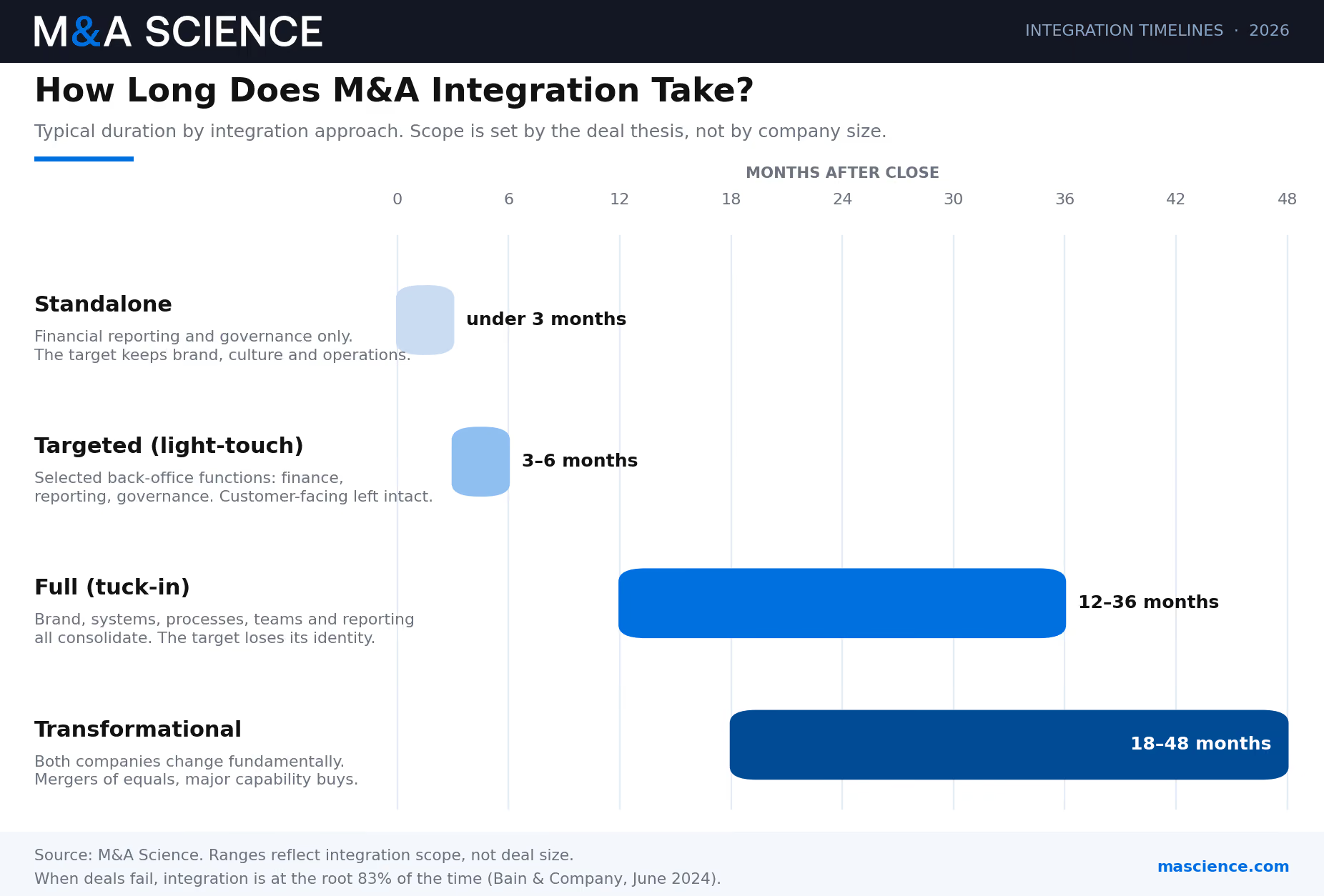
Not every acquisition requires full integration. The right approach depends entirely on the deal thesis, or why you're buying the company and what you need from it post-close.
These are the four integration approaches used across the market:
Standalone Integration
The acquirer decides that any meaningful integration would disrupt the target's business and reduce its value. The acquired company keeps its own brand, culture, leadership, and operations. The acquirer gains financial control and reporting visibility, nothing more.
This approach is most common in financial acquisitions or cases where the target is a market leader in a niche that the acquirer can't replicate. The value comes from ownership and guidance, not from connecting systems or combining teams.
When to use it: The target is successful specifically because of how it operates. Integration would break what makes it valuable.
Targeted Integration (Light-Touch)
The acquirer integrates selected functions, typically back-office operations, financial reporting or governance structures, while leaving customer-facing operations and culture intact. Also called "light-touch" integration.
This lets the acquirer capture some operational value without disrupting revenue-generating activities or unsettling the team. The result is a partial operational connection with the target retaining its day-to-day identity.
When to use it: There are specific functions where connection creates clear value, but the target's operating model should be preserved.
Full Integration
The target company is fully absorbed into the acquirer's organization. Brand, systems, processes, teams and reporting all consolidate. The target loses its independent identity.
Also called a tuck-in or absorption. Full integration is the most operationally complex approach . It requires M&A communication planning, strong Day One readiness, and a detailed integration roadmap. Done well, it delivers significant operational efficiency. Done poorly, it's costly and chaotic.
When to use it: The strategic rationale depends on achieving full operational connection: shared infrastructure, a combined go-to-market or the elimination of redundant functions.
Transformational Integration
A less common approach where the deal is designed to fundamentally change both companies, and neither the acquirer nor the target looks the same post-integration. Sometimes used in mergers of equals or major capability acquisitions.
Who Runs Integration: The Integration Management Office
The Integration Management Office (IMO) is the governance structure that runs post-merger integration. It establishes milestones, tracks metrics, governs cross-functional teams and coordinates the functional workstreams for finance, IT, HR, supply chain and go-to-market. The IMO should be established early, before close, with a named integration lead, a defined escalation path to the M&A steering committee and a cadence of decision reviews.
Acquirers who skip the IMO usually discover the gap around day 45, when five functions are making conflicting decisions and no one has clear authority to resolve them. An IMO does not need to add significant overhead, even on a small deal. If you're going for standalone or light-touch integration, it can be a single person synthesizing decisions across the standing meeting. The point is you want to define clear ownership and an escalation path before problems arise, not attempt to create them after the fact.
What Gets Integrated Functionally (and What Can Be Left Alone)
Operational alignment involves standardizing or harmonizing business functions between the two companies. Finance aligns the chart of accounts, reporting calendar and spending levels. IT aligns infrastructure, identity management and the application stack. HR aligns payroll, compensation bands and benefits. Supply chain and procurement consolidate vendor contracts and purchasing volumes. Sales and marketing align territories, quotas and go-to-market strategies.
Every alignment should have an owner, defined end state and a deadline. Without each of these, both companies might keep their own duplicate systems, processes and policies long after the merger.
Integration doesn't mean connecting everything. The scope of integration should be driven by the deal thesis, not by a standard checklist. These are the functional areas most commonly included in the integration scope:
Human Resources
Payroll systems, compensation structures, benefits and hiring processes are typically among the first integration priorities. The acquirer needs visibility into and control over workforce management. This is also where retention decisions get made, like who stays, who's offered what and what the new organizational structure looks like.
Finance and Accounting
Financial reporting integration is almost always required. The acquirer needs consolidated visibility into the acquired company's performance. This includes setting spending authority thresholds, aligning the chart of accounts and ensuring audit readiness.
Technology and Systems
Technology integration ranges from basic reporting connectivity to full system migration. The complexity depends on what the companies are running and how different their stacks are. Legacy systems used by the target are among the most common sources of unexpected integration costs.
Purchasing and Procurement
For acquirers seeking operational efficiency, integrating procurement creates leverage through combined purchasing volume, centralized vendor management and policy alignment. This is most relevant in same-industry or platform acquisitions.
Sales and Marketing
When the deal thesis involves revenue capture, such as cross-selling products, accessing new markets or combining distribution channels, sales and marketing integration is central to delivering the value the deal was priced on. Poorly executed go-to-market integration is a common reason deals underdeliver.
What to leave alone:
Not every function needs to be connected. If the target is successful because of how it manages customer relationships, serves a specific niche or operates its culture, disrupting those things to achieve operational tidiness can cost more than it saves. The M&A steering committee is typically responsible for these scope decisions.
Tracking Synergy Capture Against the Deal Model
Synergy capture is the tracking discipline that connects the integration plan back to the deal model. Cost synergies come from eliminating duplicate roles, consolidating facilities, renegotiating vendor contracts and retiring redundant systems. Revenue synergies come from cross-selling, channel access and bundled offerings.
Every synergy should have an owner with accountability, a baseline against which improvement can be measured, a target date for when the value should be realised, and a line in the financial reporting pack. That way the integration team can track whether savings or revenue gains are actually being achieved against the assumptions used in the deal model. Revenue synergies take longer to achieve and are less certain than cost synergies. For that reason, over reliance on forecast revenue synergies represents a substantial valuation risk.
When Should Integration Planning Start?
Before closing. Ideally, before the letter of intent (LOI).
Integration planning that starts on Day One after close is too late. By then, decisions have already been made that constrain your options: the deal structure, the retention agreements (or lack of them), the transition services arrangement and the IT roadmap. If integration is an afterthought in the deal process, you'll spend the first 90 days reacting instead of executing.
The best integration leaders are involved at three points:
1. During deal thesis development. The integration approach is part of the valuation. The degree of integration required by the deal, how quickly it needs to occur and at what cost all contribute to the value a buyer can realize. If a buyer underestimates the expense and complexity of full integration they may overpay for the acquisition. If a buyer assumes the target will run entirely on its own with little integration they may not invest enough to properly integrate the new assets.
2. During confirmatory due diligence. The integration team should be learning alongside the diligence team, not reading their reports afterward. What you learn about the target's systems, culture, people and processes during due diligence directly shapes what the integration plan needs to address.
3. During pre-close planning. The 60-90 days between signing and closing are your best window for integration planning. Day One readiness, functional workstreams, governance structure and communication plans should all be drafted and ready to execute at close.
Want to run integration the way this article describes, starting before close instead of after? The Buyer-Led M&A™ Certification covers synchronized diligence and integration, 100-day planning, and value capture, taught by practitioners who've done it. Start the certification →
The Biggest Integration Risks (and How To Catch Them Before Close)
When it comes to integration risks, the most common failures are predictable. But only if you're looking for them.
Key employee departure. The people who created the value you bought often leave within the first 12 months if they lack clarity about their role, feel undervalued or don't trust the new leadership. Retention decisions need to be made before close, not reactive after attrition starts.
Culture clash. A small, fast-moving company acquired by a large enterprise will face friction when approval processes, reporting requirements and decision-making speed change overnight. This kills velocity and morale.
System incompatibility. Buyers frequently underestimate the effort involved to consolidate legacy technology and connect incompatible systems. A task that seemed simple at due diligence, like migrating data, can turn into months of integration work including application consolidation, data cleanup, system dependencies, security requirements and business process changes.
Integration scope creep. Selecting inappropriate integration levels can result in unnecessary costs, fragmentation of the target or orphaned functions. The company may over-integrate where functions should remain separate, or fail to consolidate when needed. Lacking an overarching deal thesis to guide what will and won't be integrated, "creeps" can occur as individual functions make decisions in silos.
Communication failure. Employees, customers and partners all need clear answers about what's changing and when. A missing or delayed M&A communication plan creates a vacuum that gets filled by rumors.
The best time to surface integration risks is during diligence. Integration leaders who are involved early can build mitigation into the integration plan before the deal is structured, rather than scrambling for solutions after close. Here is how spreadsheets and email can stall diligence.
Frequently Asked Questions
What is M&A integration?
M&A integration is the process of combining an acquired company’s operations, systems, people and culture with those of the acquirer after a deal closes. The goal is to execute on the deal's strategic rationale and deliver the value the acquisition was designed to create.
What's the difference between M&A integration and post-merger integration (PMI)?
They mean the same thing. Post-merger integration (PMI) is the formal term commonly used in corporate development, while M&A integration is the more common shorthand. Both refer to the work required to connect two companies following an acquisition and to ensure they operate effectively together.
What are the main types of M&A integration strategies?
The four main types are: standalone (the target keeps its identity and operations intact), targeted/light-touch (selective function integration while preserving the target's operating model), full integration/tuck-in (the target is fully absorbed into the acquirer) and transformational (both companies change fundamentally as part of the deal).
When should integration planning start?
Integration planning should start before close, ideally before the LOI. Integration planning that begins on Day One after close is too late. The integration approach, key retention decisions, Day One readiness and functional workstream plans should all be in place at signing, ready to execute at close.
How long does M&A integration take?
M&A integration typically takes 3 to 36 months depending on the scope. A targeted integration of back-office functions completes in 3 to 6 months. A full integration of a significant business unit runs 12 to 36 months. Transformational integrations involving culture change, system migration and go-to-market alignment take longest. The integration timeline is set by the deal thesis and the number of systems being consolidated, not by company size.
What's the biggest reason M&A integration fails?
The most common failure isn't operational; it's that integration was treated as a post-close activity rather than a pre-close priority. By the time integration planning starts, the decisions that constrain the options (deal structure, IT roadmap, retention agreements) have already been made without the integration team's input.
Does every acquisition require full integration?
No. The right integration approach depends entirely on the deal thesis. Some acquisitions are designed to capture value through standalone operation with minimal disruption. Forcing full integration on a business where the value is in its independence is a common (and costly) mistake.
What functions are most commonly integrated in an acquisition?
Finance and reporting, human resources and payroll, technology and systems, and procurement are the most common starting points. Sales and marketing integration follows when the deal thesis depends on realizing go-to-market synergies. Culture and branding integration is more complex and depends on the integration approach chosen.
Is M&A integration a good career?
M&A integration is a strong career path for operators who want deal exposure without the grueling hours associated with investment banking. Integration leaders are tasked with leading the integration work between corporate development and operations functions. Responsibility includes ensuring delivery against defined integration milestones and capturing the overall value expected from the deal.
The cross functional nature of the role allows for early exposure to how different parts of a company (finance, operations, technology, HR, etc.) intersect. Additionally, the work tends to attract those that are comfortable working in ambiguity and influencing people outside of their direct control. Many M&A integration leaders are internally promoted from within finance, IT, HR or program management backgrounds (versus traditional investment banking). The cross-functional leadership developed while working in an integration role can also allow a path to broader operating roles such as COO or Chief of Staff.


